

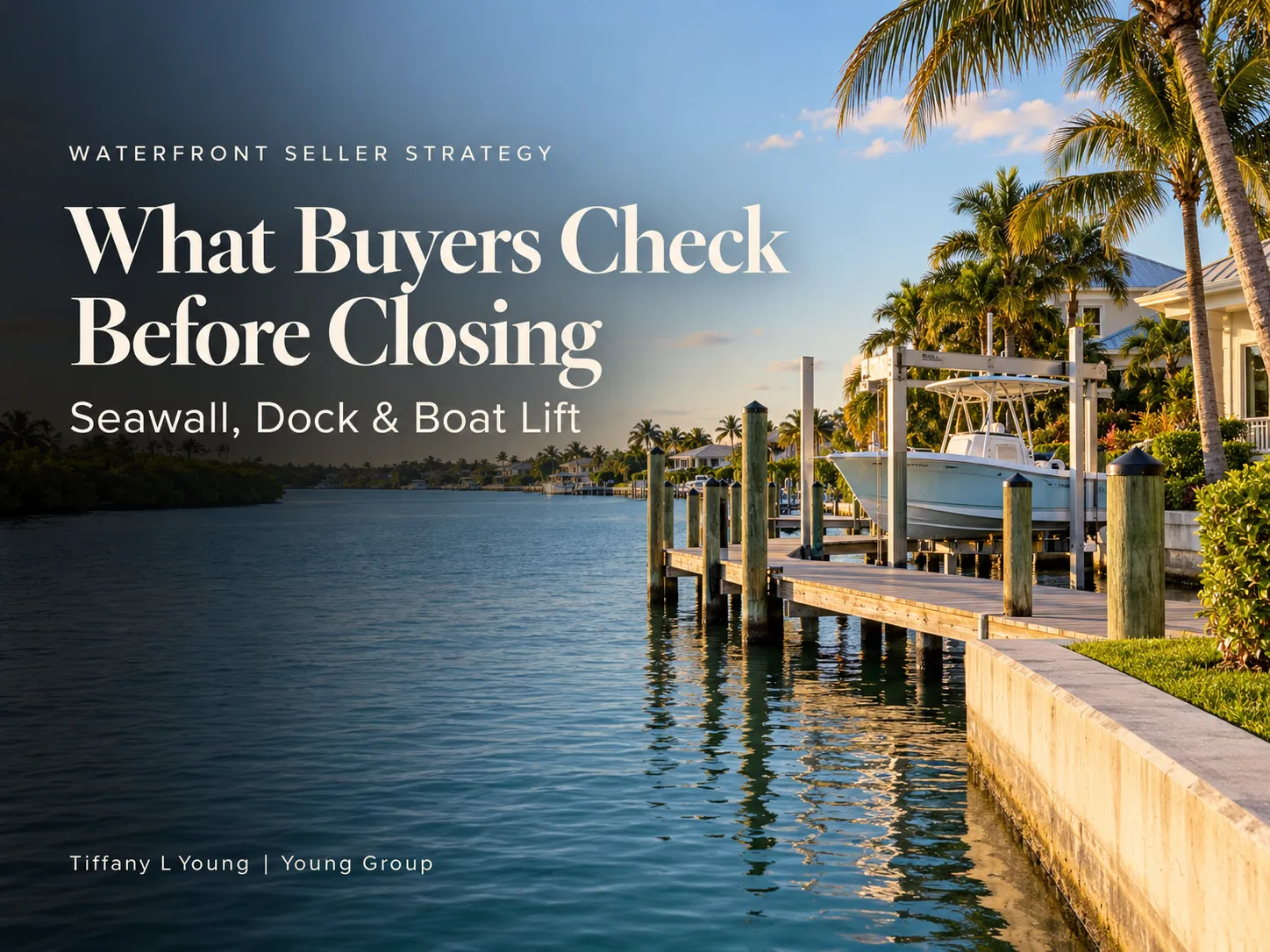
Selling a Stuart Waterfront Home
Seawall, dock, and boat lift considerations
What waterfront buyers check before closing
Waterfront buyers often want to understand the seawall’s condition, the dock’s permit history, and the boat lift’s condition and capacity before they close. Having those answers ready can reduce uncertainty during negotiations. Missing documentation or unexpected defects can lead to repair requests, renegotiation, delays, or cancellation when the contract allows it. Start with the condition assessment and permit records, then decide whether to repair, negotiate a credit, or sell as-is.
A cosmetic update may take a weekend. A seawall project can take much longer, which is why waterfront preparation deserves attention before a home goes on the market.
On the St. Lucie River, the Indian River Lagoon, and the canals around Stuart, Sewall’s Point, Palm City, and Jensen Beach, water frontage can be a significant part of a home’s value. For sellers of $1 million-plus waterfront homes, the condition and usability of that frontage deserve a place in the pricing and preparation plan.
What buyers and inspectors look at
Don’t assume the home inspection includes the seawall, dock, or boat lift. Confirm the inspector’s scope and arrange a separate evaluation by a qualified marine professional when needed. Structural concerns may require a Florida-licensed engineer, and dock electrical systems may require a licensed electrician.
The seawall. An evaluation may identify cracks, leaning or bowing, soil loss behind the wall, sunken pavers, and drainage problems. A wall can appear sound from the lawn while having problems below the surface. Warning signs need professional interpretation; a visible crack alone doesn’t establish whether replacement is necessary.
The dock and pilings. The evaluation should address decking, connections, cleats, ladders, pilings, and accessible electrical components, including appropriate GFCI protection. Underwater portions of wood pilings may deteriorate without obvious damage above the waterline. Confirm whether underwater inspection is included.
The boat lift. Have the professional verify the manufacturer’s rated capacity and evaluate the applicable cables, motors, controls, cradle, and drive components. Compatibility depends on the boat’s loaded weight and dimensions, as well as the lift design and installation. A buyer’s preferred boat may require adjustments or different equipment.
Gather installation dates, maintenance records, warranties, past repair invoices, and engineering reports wherever available. These records support the evaluation; they don’t replace it.
Repair credit or sell as is
There’s no single right answer. What matters is understanding the condition, likely scope, and cost before you negotiate.
- Targeted repair. A qualified professional may recommend localized work, such as repairing a cap, addressing soil loss, or replacing damaged pilings. The appropriate solution depends on the cause and extent of the problem.
- Full replacement. If the structure is no longer serviceable or repairs offer limited remaining life, compare replacement with repair. Get written local proposals that identify engineering, demolition, materials, access, permitting, and any exclusions.
- A negotiated credit. A written bid can give both parties a useful basis for negotiation. If the buyer is financing the purchase, confirm the proposed credit with the lender and closing professional. A credit may not resolve a condition the lender requires to be repaired before closing.
- Sell as-is with documentation. A buyer may prefer to control the work after closing. Make known material defects clear, provide available reports and proposals, and consider the condition in your pricing strategy. An as-is sale doesn’t remove disclosure obligations.
Avoid choosing between repair and replacement based only on a percentage rule. Consider structural condition, expected remaining service life, applicable code requirements, and the scope of each proposal. Costs vary by wall type, water depth, soil, access, and permitting, so a nonlocal price-per-foot estimate shouldn’t substitute for a bid on your property.
I evaluate waterfront condition alongside the property’s competitive position through my Coastal Valuation Method™. Read more about how to price a home on the Treasure Coast.
Permits can set your timeline
Don’t promise a finished seawall by closing before confirming the approvals and construction schedule. Start by identifying the property’s permitting jurisdiction; a Stuart mailing address doesn’t necessarily mean the property is within city limits.
For projects handled by Martin County, repair or replacement of previously permitted seawalls begins with the Building Department. New seawalls and preexisting unpermitted shoreline structures follow a different review path and may involve Growth Management as well as building approval. The county’s residential seawall checklist includes a survey or site plan, sealed plans, engineered drawings, and DEP approval or an applicable exemption. Contact the Martin County Building Department at 772-288-5916, or the appropriate municipal department, to confirm the requirements for your project.
Certain seawall restorations and dock repairs may qualify for state permitting exemptions under section 403.813, Florida Statutes, subject to location, size, construction, and environmental conditions. An exemption doesn’t eliminate every other applicable approval requirement. New vertical seawalls in estuaries and lagoons face additional restrictions, with limited exceptions. Have your contractor or permitting professional confirm the applicable state, local, federal, and submerged-land requirements before setting a timeline.
Docks and lifts: what conveys and what is permitted
Three questions deserve attention before listing.
What is the dock’s approval history? Gather local permit records, final inspections where required, and any available state or federal approvals, exemptions, or submerged-land authorizations. Compare the approved plans with the existing structure, including later modifications. A local permit record alone may not establish every approval needed for the dock.
A dock’s age alone doesn’t establish legal status or rebuilding rights. Verify any restrictions on repair, expansion, or reconstruction rather than relying on a description such as “grandfathered.”
What stays with the house? An attached boat lift may convey as a fixture under the purchase contract unless specifically excluded. Confirm ownership and the contract terms, and identify the lift, davits, floating platforms, dock boxes, and other accessories as included or excluded where appropriate. Removable accessories may be treated differently from attached fixtures.
If a buyer plans to change the lift or dock layout, confirm feasibility first. Certain floating lifts and vessel platforms qualify for permitting exemptions, but those exemptions don’t apply to every boat lift.
What does insurance cover? Ask your insurance agent whether the dock and lift are covered, for which causes of loss, and subject to what limits, deductibles, and exclusions. Don’t assume the home’s coverage applies to every waterfront structure or storm-related loss.
What Florida law requires sellers to disclose
Florida sellers must disclose known facts that materially affect residential property value, are not readily observable, and are not known to the buyer. This duty applies to as-is sales too. Known seawall failure, concealed dock damage, or a material lift defect may fall within that obligation. A repair quote can help document the underlying condition, but the quote itself isn’t necessarily a material defect.
Florida doesn’t require one universal general seller-property-disclosure form. The Florida Realtors Seller’s Property Disclosure – Residential is a commonly used form. Florida separately requires the statutory flood disclosure at or before execution of the sales contract. It addresses known flooding damage during ownership, flood-related insurance claims, and assistance received for flood damage. I walk through all three questions in my guide to Florida flood disclosure for Treasure Coast sellers.
If you’re unsure about your legal obligations, consult a Florida real estate attorney. Written disclosure and organized supporting records can help buyers understand the condition before negotiations become time-sensitive.
A prelisting checklist for waterfront sellers
- Arrange an appropriate evaluation of the seawall, dock, pilings, and lift, and confirm whether underwater and electrical assessments are included.
- Gather permit and approval records from the appropriate local jurisdiction and other applicable agencies. Identify unresolved permits or discrepancies.
- Get written local bids for significant issues identified in the evaluation.
- Decide with your real estate agent whether to repair, negotiate a credit, or sell as-is. Confirm financing limitations if a credit is proposed.
- Ask your insurance agent to explain coverage for the dock and lift.
- Confirm ownership and document which fixtures and accessories convey or are excluded.
- Gather warranties, maintenance records, repair invoices, and engineering reports, and complete applicable disclosures.
Frequently asked questions
Do I have to repair my seawall before selling in Stuart?
You generally don’t have to repair a seawall simply to list a home, but an unsafe condition, enforcement order, or other property-specific obligation may require action. Known material defects must be disclosed when the disclosure duty applies. Buyers may request repairs, a credit, or a price adjustment, and financing requirements can affect the options.
Does a seawall repair need a permit in Martin County?
Confirm the requirements before starting work. Martin County directs repair or replacement of previously permitted seawalls through its Building Department. New seawalls and existing unpermitted structures may require a different review process. State exemptions don’t automatically remove applicable local or other approval requirements.
Does the boat lift stay with the house?
An attached boat lift may convey as a fixture under the purchase contract unless specifically excluded. Confirm ownership, contract terms, and exclusions, and clearly identify the lift and dock accessories to avoid disputes at closing.
Can I add a dock or lift if the property does not have one?
Possibly, but approval isn’t automatic. Water depth, navigation, seagrass, environmental protections, neighboring riparian rights, and site-specific restrictions can affect feasibility. Have a qualified professional confirm what can be authorized before relying on a future dock or lift as part of your purchase decision.
How much does a seawall replacement cost?
There’s no reliable single price for every Stuart waterfront property. Materials, wall length and design, water depth, soil, demolition, construction access, engineering, and approvals all affect the total. Get written local proposals with comparable scopes before deciding how the project should affect your asking price or negotiations.
Your next step
Your seawall, dock, and lift can influence your home’s value and the buyer’s decision. Knowing their condition and the likely scope of any work gives you a stronger basis for planning your sale.
Thinking about selling a waterfront home on the Treasure Coast? Request a complimentary home valuation, and I’ll help you evaluate pricing, timing, and waterfront preparation priorities. For an overview of the process, read selling a home on the Treasure Coast.
About Tiffany L Young
Tiffany L Young is the Broker of Young Group. She has spent the last 20 years helping South Florida homebuyers and sellers and serves Florida’s Treasure Coast, including Stuart, Palm City, Port St. Lucie, and Vero Beach. Her focus includes waterfront, golf and country club, and luxury homes, helping homeowners sell strategically and buyers find the right home in the right community.
Young Group. This article provides general information, not legal, engineering, or insurance advice.
Sources
- Martin County Residential Seawall Checklist
- Martin County Shoreline Stabilization Application Guidance
- City of Stuart Building Division
- Florida Statutes section 403.813
- Florida Statutes section 689.302
- Florida Realtors Disclosure Guidance
- Florida Realtors Guidance on Fixtures and Contract Exclusions